
Tech Downloads
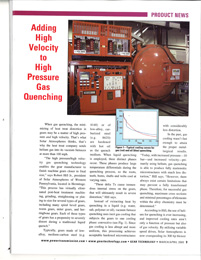
Adding High Velocity to High Pressure Gas Quenching
When gas quenching, the minimizing of heat treat distortion is gears may be a matter of high pressure and high velocity. That’s what Solar Atmospheres thinks, that’s why the heat treat company sends helium gas into its vacuum furnaces at more than 100mph.
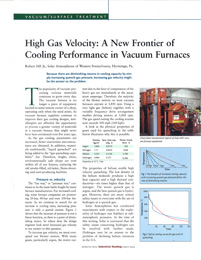
High Gas Velocity: A New Frontier of Cooling Performance in Vacuum Furnaces
Because there are diminishing returns in cooling capacity by simply increasing quench-gas pressure, increasing gas velocity might be the answer to the problem.
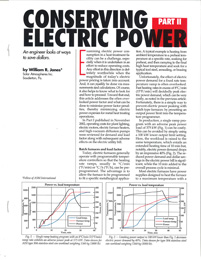
Conserving Electric Power Part II
Examining electric power consumption in a heat treatment facility can be a challenge, especially when it is undertaken in an effort to reduce operating costs. Any effort in this direction is definitely worthwhile when the magnitude of today’s electric power pricing is taken in to account.
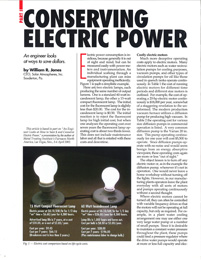
Conserving Electric Power Part I
This article is in part on “An Engineer’s View on how to conserve $ and electric power”, presented at the Metal Treating Institutes Furnaces North America, Las Vegas NV April 3-4, 2002. This article is part 1 of a two part series.
High Pressure Gas Quenching Typical Oil Hardening Grades of Steel
High pressure gas quenching has been identified as one of the most important advancements in recent developments of heat treating technology. Over the decades, an extensive amount of research and documentation has been published on the hardenability of water and oil hardening grades of steels. To date, there is relatively little or no information on the hardenability of oil hardening grades of steel quenched in a high pressure, gas environment.

Cryogenic Treatment Review
Claims for the benefits of cryogenic treatment abound. Research also abounds, but with differing conclusions. Yet, results have proven helpful, even dramatic, for the wear life of metal parts, dies and tooling applications after cryogenic treatment.
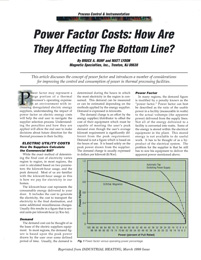
Power Factor Costs: How are They Affecting the Bottom Line?
This article discusses the concept of power factor and introduces a number of considerations for improving the control and consumption of power in thermal processing facilities.
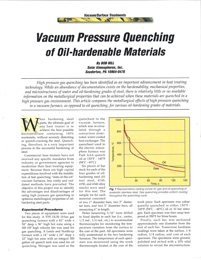
Vacuum Pressure Quenching of Oil-Hardenable Materials
High pressure gas quenching has been identified as an important advancement in heat treating technology. While an abundance of docume ntation exists on the hardenability, mechanical properties, and microstructures of water and oil-hardening grades of steel, there is relatively little or no available information on the metallurgical properties that can be achieved when these materials are quenched in a high pressure gas environment.
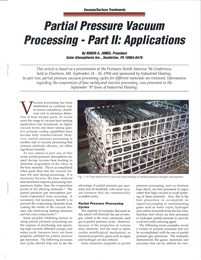
Partial Pressure Vacuum Processing – Part II: Applications
This article is based on a presentation at the Furnaces North America ’96 Conference, held in Dearborn, MI, September 24-26, 1996 and sponsored by Industrial Heating. In part two, partial pressure vacuum processing cycles for different materials are reviewed. Information regarding the evaporation of base metals and reactive processing was presented in the September ’97 issue of Industrial Heating.
Partial Pressure Vacuum Processing – Part I
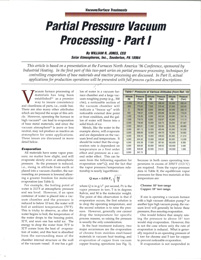
This article is based on a presentation at the Furnaces North America ’96 Conference, sponsored by Industrial Heating. In the first part of this two-part series on partial pressure processing, techniques for controlling evaporation of base materials and reactive processing are discussed. In Part II, actual applications for production operations will be presented with full process cycles and descriptions.