
Tech Downloads
Basic Vacuum Practice by Varian
Basic vacuum practices, a primer and basic introduction for vacuum technicians
Assessing Work-Basket Alloys for Vacuum Furnaces
A commercial heat treating company draws on its experience and test results to determine which high-temperature alloys use for vacuum furnace baskets.
Operating Experience with a New Reactive Ion Plating Unit for TiN Coating
During 1986, a physical vapor deposition titanium nitride reactive ion plating unit, the first of its kind shipped to the U.S., was put in to operation. It was designed for electron beam evaporation of titanium, utilizing triode plasma configuration and hot filament ionization assist. This article outlines some start-up and learning problems, and describes present equipment, Vacuum Furnace Systems Corp. modifications, and helpful processing tips.
Vacuum Furnace Brazing Large Segments of Heat Exchanger For Nuclear Fusion Reactor
Five large heat exchanger segments for an experimental power reactor (Tokamak) for Princeton Plasma Physics have been successfully vacuum furnace brazed. Each segment was brazed, one at a time, in a vacuum furnace (Model HL66) at Solar Atmospheres, Inc.
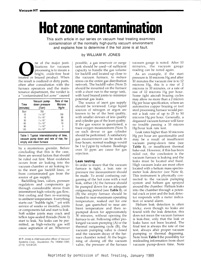
Hot Zone Contamination
This sixth article in our series on vacuum heat treating examines contamination of the normally high-purity vacuum environment and explains how to determine if the hot zone is at fault.
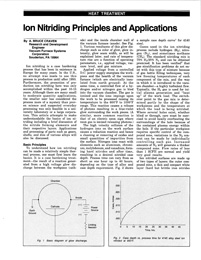
Ion Nitriding Principles and Applications
Ion nitriding is a case hardening process that has been in existence in Europe for many years. In the U.S., no attempt was made to use this process in production until after 1950. Furthermore, the promotion of production ion nitriding here was only accomplished within the past 10-15 years. Although there are many small to moderate quantity applications, the smaller user has considered the process more of a mystery than proven science and suspected everyday processing was only feasible in a university laboratory or a large corporation.
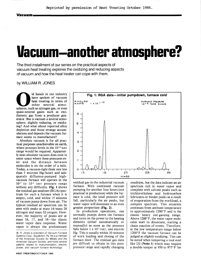
Vacuum-Another Atmosphere?
The third installment of our series on the practical aspects of vacuum heat treating explores the oxidizing and reducing aspects of vacuum and how the heat treater can cope with them.
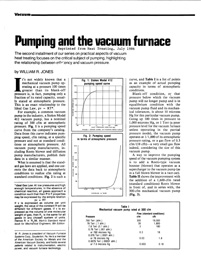
Pumping and the Vacuum Furnace
The second installment of our series on practical aspects of vacuum heat treating focuses on the critical subject of pumping, highlights the relationship between efficiency and vacuum pressure.
High-Velocity Gas Flow Seen as Key to Rapid Quench
Both theoretical calculations and experience indicate that high-velocity gas flow resulting in gas turbulence within the furnace hot zone is the principal factor for rapid quenching. Therefore, a high-volume recirculating gas atmosphere is essential for providing high-cfm flow through the work zone while conserving gas.
Why Vacuum?
The third installment of our series on the practical aspects of vacuum heat treating explores the oxidizing and reducing aspects of vacuum and how the heat treater can cope with them.